

Carnival Mumming (Workshop 10) (12 February 2025)
The Carnival-themed children's handhandcrafts workshop of the FolkReAct project was held on 12 February 2025. At the beginning of the session, the participants discussed the traditions and customs of Carnival (farsang).In 2025, the Carnival season lasts for 58 days, spanning from Epiphany (6 January) to Shrove Tuesday (4 March), with the preceding Sunday marking the start of the 'Tail of Carnival' (Farsang farka).
Epiphany traditionally commemorates the baptism of Jesus in the River Jordan and the visit of the Three Wise Men after the birth of the infant Jesus, reflecting how the star guided the three kings to Bethlehem.
The season concludes on Shrove Tuesday, which precedes the start of the forty-day period of Lent.
During this winter period, before the agricultural work commenced, people rejuvenated themselves and organised community celebrations. The 'Tail of Carnival' refers to the final three days of the Carnival period, from Carnival Sunday to Shrove Tuesday, celebrated with grand festivities. The purpose of these balls, costume parades, and carnivals is to bid farewell to winter and celebrate the approach of spring.
A major topic of discussion at the workshop was the busós of Mohács and the Busójárás (Busó Festivities). This is a unique Hungarian tradition during which the busós, dressed in frightening disguises, drive winter away through ritual noise-making. The Busójárás is the pinnacle of the 'Tail of Carnival' in Mohács. Its origins date back to the Ottoman occupation; according to legend, the Šokci people, who had fled into the swamplands of Mohács Island, donned terrifying masks and used noise-making devices to drive the Turks out of the town. This tradition is preserved to this day, becoming a symbol of banishing winter and welcoming spring. The main characters, the busós, wear fearsome masks, sheepskin cloaks turned inside out, traditional leather sandals (bocskor), and cowbells. Their characteristic accessories are clappers and maces, which they use to make noise. Moving through the town streets in organised groups, the busós successfully frighten winter away.
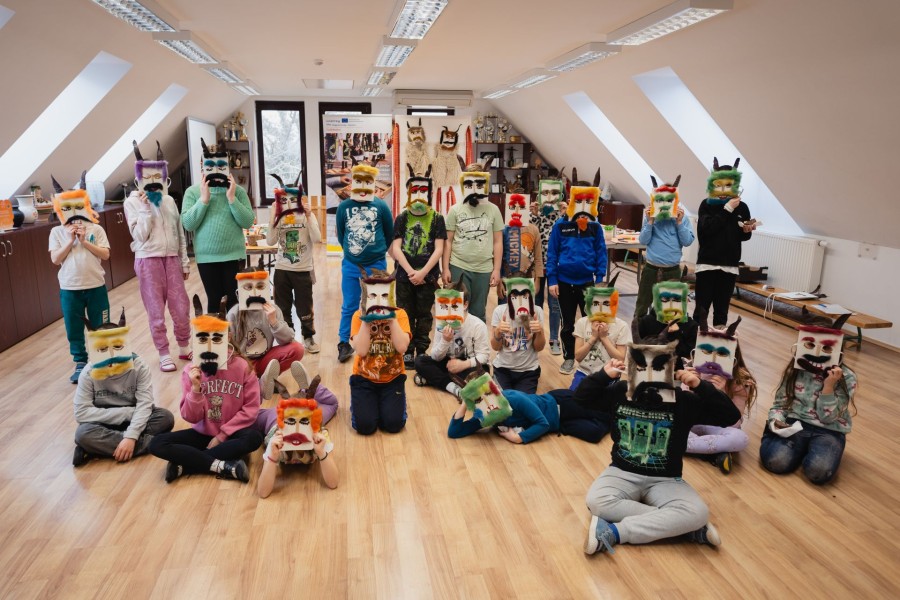
During the handhandcrafts activity, the children decorated pre-prepared paper masks using lentils and beans, gluing on mouths and teeth. Using coloured wool, they recreated the distinctive features of the busó masks, adding moustaches, eyebrows, hair, and beards. To complete their work, they secured the masks to their heads with elastic bands—you can see these winter-frighteners here!
Naturally, the session concluded with eating doughnuts and making plenty of winter-banishing noise.